

How To Draw Full Section Views
The technique called section views is a very important aspect of design and documentation. It is used to
- amend the visualization and clarity of new designs,
- analyze multiview drawings,
- reveal interior features of parts, and
- facilitate the dimensioning of drawings.
For mechanical drawings department views are used to reveal interior features of an object when subconscious lines cannot properly correspond them (due east.g., with multiple interior features and excessive overlaying subconscious lines). In other words, a primary reason for creating a section view is the elimination of hidden lines.
Architectural drawings utilise section views to reveal the interior details of walls, ceilings, floors, and other elements of the building structure.
Sectional drawings are multi-view technical drawings that incorporate special views of a part or parts, which reveal interior features. Sectioning uses a technique that is based on passing an imaginary cutting airplane through a function.
In the figure, views a are Standard multiview projections. Views b are Multiview projection with cutting plane placement and Section view. As you can meet, the subconscious features can be explicitly seen later sectioning.
General principles
- A sectional view represents the role of an object remaining after a portion is causeless to have been cut and removed.
- The exposed cut surface is then indicated by department lines.
- Hidden features behind the cutting plane are omitted, unless required for dimensioning or for definition of the part.
As y'all can in the figure here the lines of the edges between surfaces on the rear side of the part, shown as hidden lines on the non-cutting multiview drawing, disappear from the department view.
Visible surfaces and edges that correspond a modify of planes or surfaces behind the cutting plane are drawn in a department view:
All subconscious lines behind the cutting plane must not exist shown, simply all visible lines should be shown!
Section lines and symbols
Section lines, or hatching, that represent the cut surface ordinarily consist of thin parallel lines, as shown below, fatigued at an angle of approximately 45° to the principal edges or axes of the office.
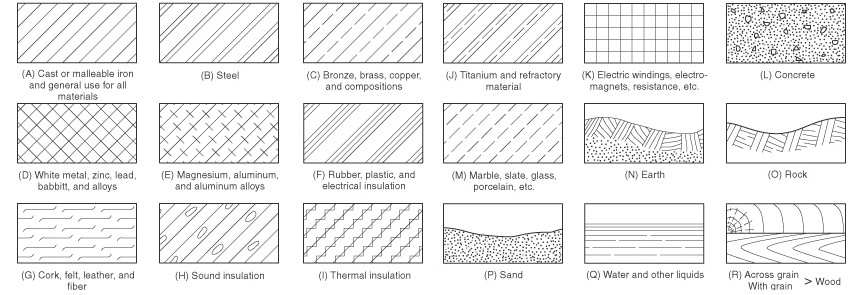
For most purposes, the full general employ symbol of cast iron is used. When it is desired to indicate differences in materials, for example on assembly drawings involving a variety of materials, other symbolic section lines may exist used.
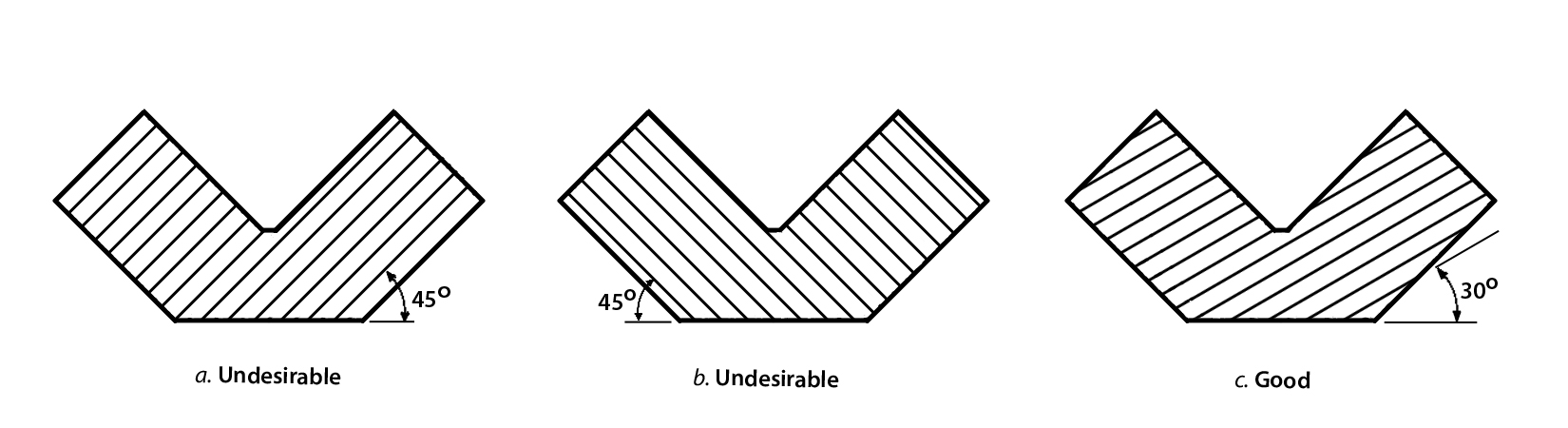
If the section lines appear to be parallel, or about so, to one of the sides or features of the office, you should cull other than 45 0 angle. Section lines should not run parallel or perpendicular to the visible outline.
The general purpose or cast atomic number 26 section line is drawn at a 450 angle and spaced 1/16" (i.5mm) to 1/viii" (3mm) or more depending on the size of the cartoon.
- In all sections of a single component, department lines should exist similar in direction and spacing, but next parts should be department-lined in different directions, angles, or spacing.
- Section lines should be thinner than visible lines.
- Do not run department lines beyond the visible outlines or stop them likewise brusk.
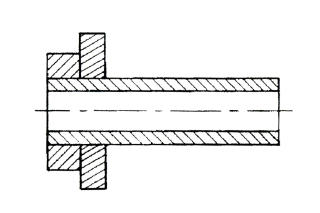
- Section lines should exist suitably spaced in relation to the size of the surface area covered, and for large areas it is recommended that section lines exist shown only along the edges.

- Thin elements should not exist sectioned.
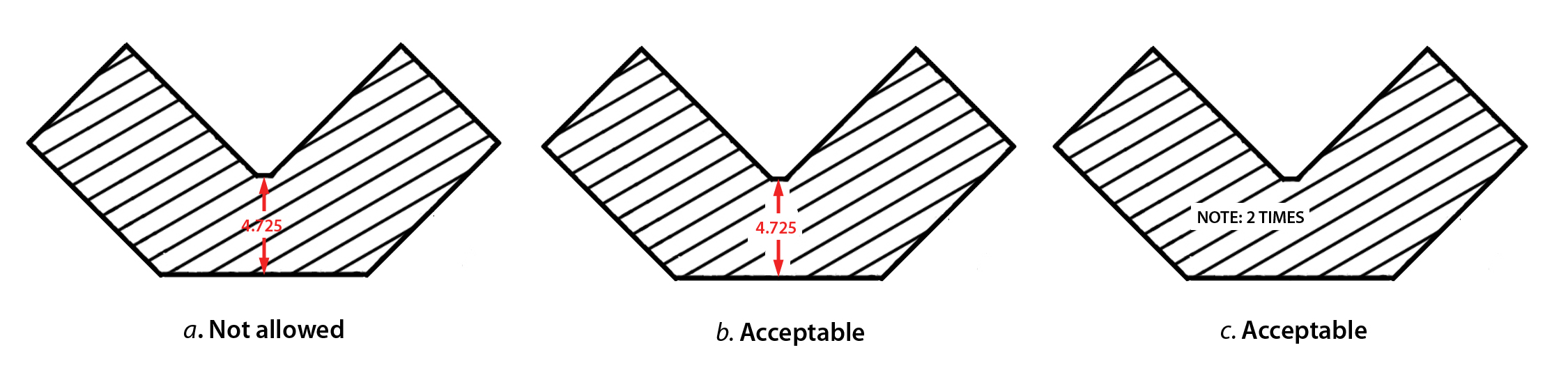
Avoid placing dimensions or notes within the department-lined areas. Nevertheless, where the insertion of dimensions or lettering in sectional areas is unavoidable, omit the section lines in the area of the notation.
Cut planes
Cutting plane lines which evidence where the cut plane passes through the object, represent the edge view of the cut plane and are fatigued in the view(s) adjacent to the department view.
Here the cutting plane is drawn every bit an edge in the top view, which is adjacent to the sectioned front end view. This is a frontal cutting airplane. Lines of sight should always be directed upwards on the top view for sectioned front view.
A horizontal cutting aeroplane is 1 where it is an border in the front view and the superlative view is sectioned.
If the cut plane appears every bit an border in the top and forepart views and the profile view is sectioned, it is a profile cutting plane.
In the drawing you must show the cutting plane line either on front view (with the top sectioned view) or on superlative view (with the frontal section view), not on both.
Two types of lines are adequate for cut aeroplane lines in multi-view drawings. Position of the line-of-sight arrows besides tin vary. But it is important to utilise only one type of cutting plane line in a single drawing.
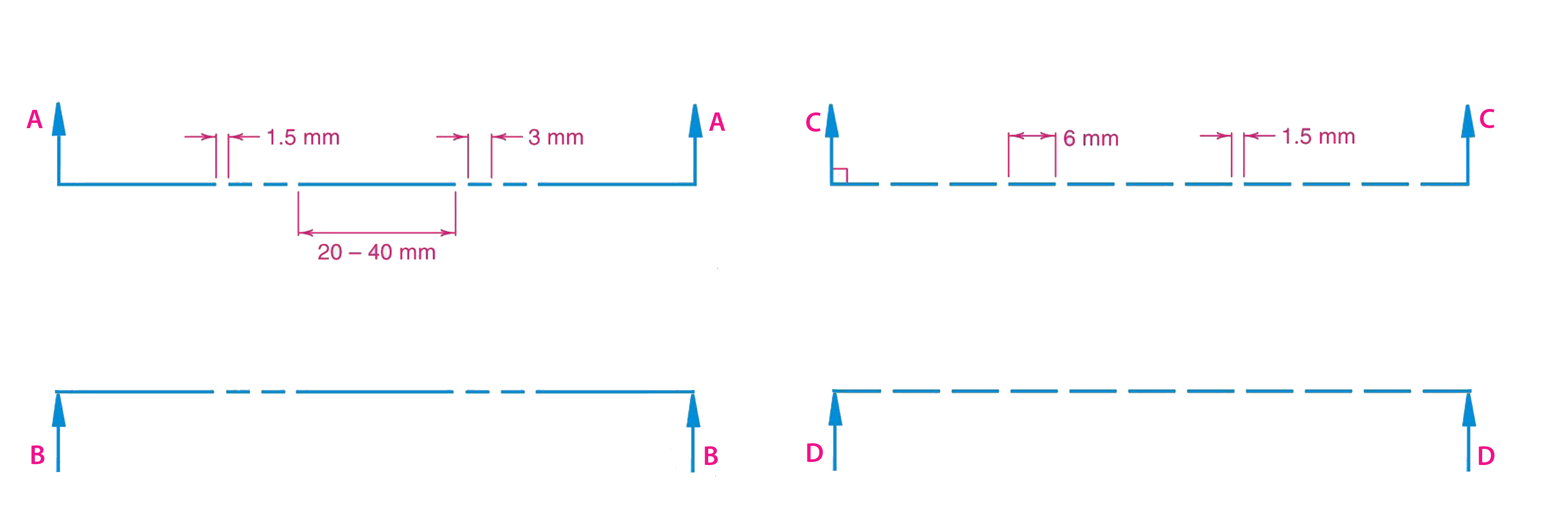
Cutting plane lines are thick (0.6 mm) dashed lines, that extend by the edge of the object 6mm (1/4") and have line segments at each stop drawn at 90 degrees and terminated with arrows. The arrows represent the direction of the line of sight for the section view and they point away from the sectioned view.
The long dash can be diffuse for big section drawings to relieve time and create a more readable drawing.
Multiple sections can be washed on a single object.
Cut planes shall not be shown on exclusive views.
To include features that are not in a straight line, the cutting plane may exist offset or aptitude at one or more than ninety0 angles, to include several planes or curved surfaces. Information technology is chosen get-go section and is used for circuitous parts that have several important features that cannot be sectioned using a direct cutting airplane.
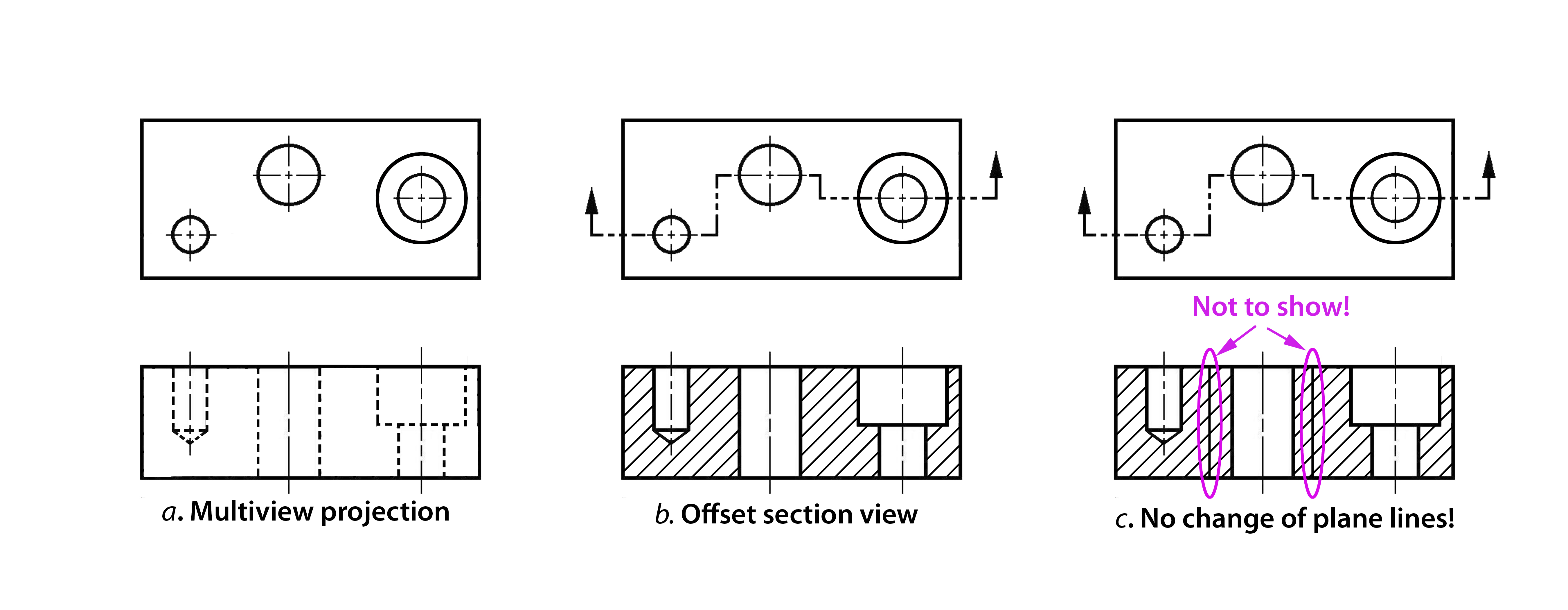
The change of plane that occurs when the cutting plane is bent at xc0 is non represented with lines in the section view !
Sometimes it is non necessary to cut the whole role to show the section view. Objects that are symmetrical almost a centre line you may draw having ane half equally a multiview and the other half in section view. In such situation
- Cutting plane line is shown across the whole office;
- Section airplane through middle line of a symmetric part tin be omitted;
- Hidden lines in half sections are usually omitted.
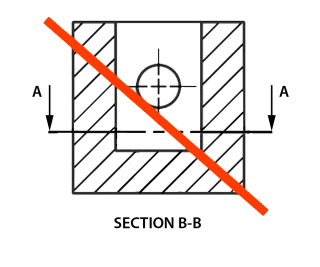
Again: In case of half sections, if there are hidden feature lines corresponding to full lines in the sectioned half, such hidden lines should exist omitted from the full view. In this sense, the cartoon shown hither is not right, since the hidden lines are shown on the sectioned role of the view. They should have been omitted!
In some cases it is more convenient to use a partial section.

A broken-out section is used when simply a portion of the object needs to be sectioned. The following figure shows a function with a portion removed or broken away.

A broken-out section is used instead of a half- or full-department view to save time, and a suspension line is drawn freehand to represent the jagged edge of the break.
There is one more type of sections which may be useful to know. Revolved section is made by revolving the cross section view of a feature 90° about an centrality of revolution and superimposing the section view on the orthographic view.
If the revolved department view does not interfere or create confusion on the view, then the revolved section is fatigued directly on the view using visible lines, every bit shown in the view b of the effigy. When the revolved view is superimposed on the part, the original lines of the part behind the section are deleted. If the revolved section crosses lines of the view on which it is to be revolved, then the view tin can be broken for clarity, as you tin can run across in view c.
The shape of the cross-section of a bar, arm, spoke, or other elongated object may be shown by means of a revolved section.
Sparse wall sections. Ribs, webs, spokes, gear teeth and other sparse features are not section lined when the cutting aeroplane passes parallel to the feature. Calculation department lines to these features would requite the faux impression that the part is thicker than information technology really is. In the effigy you tin see cutting planes that pass parallel to and through the web.
Leaving sparse feature unsectioned only applies if the cutting airplane passes parallel to the feature (SECTION A-A). If the cutting plane passes perpendicular or crosswise to the characteristic (Section B-B), section lines are added.
Chief Principles of Placement of Sectional Views
- Whenever practicable, and except for revolved sections, you should project sectional views perpendicular to the cutting airplane and place it in the normal position for third angle projection.
- You should never show the views in first angle projected position on a 3rd angle projection cartoon.
- When the preferred placement is not practical you may remove the sectional view to some other user-friendly position on the cartoon, but information technology must be conspicuously identified, usually by two capital messages, excluding I, O, Q, and Z, and be labelled.
- Normally, y'all should not change orientation of the view, but if this becomes necessary, you must land the number of degrees through which it is revolved.

Source: https://www.mcgill.ca/engineeringdesign/engineering-design-process/basics-graphics-communication/sectioning-technique
Posted by: rodriguezsument.blogspot.com
0 Response to "How To Draw Full Section Views"
Post a Comment