

How To Run A Natural Gas Line From My House To An Unattached Garage Youtube
Natural gas is odorless until we add mercaptan, an odorant similar to rotten eggs, to help discover leaks. If you smell natural gas or have a natural gas emergency, leave immediately and telephone call us from another location.
Natural gas leaks: 800-261-5325
Safety tips
Natural gas is safe when properly used. Follow these tips to prevent accidents:
- Install and maintain at least one carbon monoxide detector on each flooring of a abode or business.
- Never utilize your oven or range for heating a home.
- See if gas range flames are crisp, quiet and blue. Yellow flames indicate need for adjustment.
- Clean range tops by washing burners with water and mild detergent.
- Go on an all-purpose fire extinguisher in a kitchen.
- Make clean or supersede air filters in heating systems at to the lowest degree annually.
- Keep chimney flues and appliance vents make clean and in good repair.
- Have a qualified contractor inspect furnaces, vents, appliance connectors and chimneys for corrosion and blockages at least every other year.
- Keep areas around furnaces and h2o heaters clean and complimentary of clutter and flammable liquids.
- Check water heater air intakes, drain pipes, controls and flue to ensure they are unobstructed.
- Set water heater temperature to 120 degrees F to prevent scalding.
- Never hang things from natural gas piping.
- Follow a infinite heater'south instructions carefully and use with proper ventilation.
- Take corrugated stainless steel tubing inspected to brand sure is properly bonded and grounded.
- Proceed gas meters free of debris, snowfall, water ice, vegetation and other obstructions.
- Phone call 811 or the local utility locating service at to the lowest degree three days before yous programme to dig.
Appliance connections
Brand sure your appliance connectors are safe. Older connectors made from contumely may crack, break or deteriorate. Even newer connectors made from stainless steel should be replaced every x years. Have a qualified HVAC or plumbing professional person inspect your gas appliances. Do not attempt to motility or inspect natural gas appliances on your own.
More data on natural gas appliance connectors
Excess menstruation valves
An backlog flow valve (EFV) is a safety device designed to automatically end the period of natural gas through the service line if it exceeds a predetermined charge per unit. When activated, an EFV may prevent the buildup of natural gas and lessen the potential for property damage and/or injury. It should exist noted that these devices generally do non protect against slow leaks, such as those caused past corrosion or loose fittings, or leaks located along customer-owned pipe beyond the natural gas meter.
Many customers already have an EFV installed on their existing natural gas service line. Customers who do not have an EFV may be eligible to accept ane installed at their ain expense. Toll typically ranges from $850 to $2,000 depending on the location and conditions of the installation site. Customers tin can asking more information about EFV installations by calling our 24-hour customer service at 800-242-9137.
Corrugated stainless steel tubing
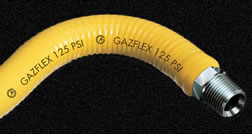
Corrugated stainless steel tubing (CSST) is a flexible tube sometimes used to supply natural gas in homes and businesses. Used since 1990, CSST may have been used for natural gas piping in your abode if you added a new natural gas appliance such as a stove or furnace. Danger: Improperly bonded and grounded CSST tin can consequence in natural gas leaks or fires in buildings struck by lightning. Learn about our CSST policy requirements. CSST is frequently coated in xanthous or black.
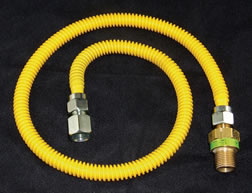
Do non misfile CSST with natural gas appliance flexible connectors. Flexible connectors typically attach straight to natural gas appliances from a floor or wall appliance close-off valve. CSST typically is routed beneath, through or forth floor joists in the basement, inside interior wall cavities and on top of ceiling joists in cranium spaces. In Wisconsin, all CSST, regardless of manufacturer exemptions, must be bonded and grounded. First generation CSST must be bonded to the structure's electrical system in accord with NFPA 70 - National Electrical Code (NEC), and NFPA 54 - National Fuel Gas Code, using bonding clamp(southward) and wire sized appropriately per the manufacturer's instructions. Inspect: If you take CSST installed at your home or concern, contact a licensed electrician to verify proper bonding. If not, the electrician tin can install proper bonding. If you lot're non certain if you have CSST, contact the visitor that installed the natural gas piping in your home or business concern and enquire for an inspection.
Natural gas distribution network
Natural gas distribution networks are subject to rigorous inspection, maintenance and oversight within our visitor and by state and federal authorities. We maintain about 20,000 miles of natural gas distribution mains and 530 miles of natural gas transmission pipelines throughout Wisconsin. We as well maintain the pipes that connect the mains to private homes and businesses. Typically, we are responsible for the natural gas facilities upward to the outlet of your meter. Maintenance of additional buried natural gas pipes on your property is your responsibleness. Examples include pipes to mobile homes, detached garages, workshops, pools, spas and lighting. Co-ordinate to federal rules, you lot are responsible to inspect buried piping on your property for leaks and corrosion. Any unsafe conditions must be repaired or removed.
Our inspection and safety activities
- We survey for possible leaks on our distribution mains every year in populated communities and every other yr in more rural areas. (Federal requirement for main surveys is once every 5 years).
- All manual pipelines are surveyed for leaks at least once per year.
- All of our i million customer service lines are inspected within every iii years. (Federal requirement for service line surveys is once every five years).
- We take corrosion protection on all steel pipe in our system. (Federal requirement requires corrosion inspections only on pipes installed prior to 1971.)
- Our corrosion protection is monitored continuously and tested every twelvemonth.
- Wisconsin limits distribution organization operating pressure at 60 psig (pounds per square inch). (Federal limit allows for distribution systems to operate at 125 psig.)
- Forth with inspecting existing lines, we invest almost $50 1000000 every year in upgrading and replacing mains and service lines throughout the expanse.
- We piece of work with local public rubber agencies to provide emergency response training and condom information.
- Each year, nosotros sponsor contractor workshops to reinforce safety guidelines for construction crews that work around natural gas and electric facilities.
For security reasons, we do not provide maps containing exact locations of pipelines. You can find pipelines in your community here: National Pipeline Mapping System. Every other yr, nosotros send out a advice to all customers within 1,000 feet of a transmission pipeline.
Pipeline rubber
Most incidents involving natural gas pipelines involve a contractor or homeowner digging into buried distribution lines. To avoid such situations, be sure to phone call 811, a national hotline for underground facility location and marking — at to the lowest degree three days prior to digging. The gratis service uses flags and paint to mark cloak-and-dagger utility facilities that should be avoided when digging. When excavating effectually natural gas piping, dig by hand.
Source: https://www.we-energies.com/safety/gas
Posted by: rodriguezsument.blogspot.com
0 Response to "How To Run A Natural Gas Line From My House To An Unattached Garage Youtube"
Post a Comment